- 11 % Newsletter
- Posts
- Radical Responsibility
Radical Responsibility
The Uncomfortable Freedom That Change Everything

Zufar Algifary
November 13, 2025

There is a fundamental truth about human existence that most people spend their entire lives trying to avoid we are condemned to be free and with that freedom comes absolute responsibility for everything we are and everything we become.
Jean-Paul Sartre’s concept of radical responsibility states that we are thrust into existences without permission, and from that moment forward every aspect of our lives becomes our choice to shape or to abandon. We cannot opt out of this freedom, because even choosing not to choose is still a choice that carries consequences.
Bad Faith
Most people live in what Satre called “bad faith”. Is the self-deception of pretending we don’t have choice when we actually do. The employee who says “I have to work this job”, the partner who claims “I can’t leave this relationship,” the dream who explains “I don’t have time to pursue my passions.” Each is living in bad faith by denying their fundamental freedom to choose differently.
Becoming the Architect of Your Own Life
The transition from bad faith into radical responsibility begins with what James Clear Would call awareness : the simple act of noticing where you’re pretending not to have choices when you actually do. Start by observing your thought and language without judgement. When you catch yourself saying “I having to” or “I can’t,” simply notice the pattern as if you were watching someone else speak. Don’t criticize yourself for these thoughts; don’t praise yourself for catching them; just observe with neutral curiosity.
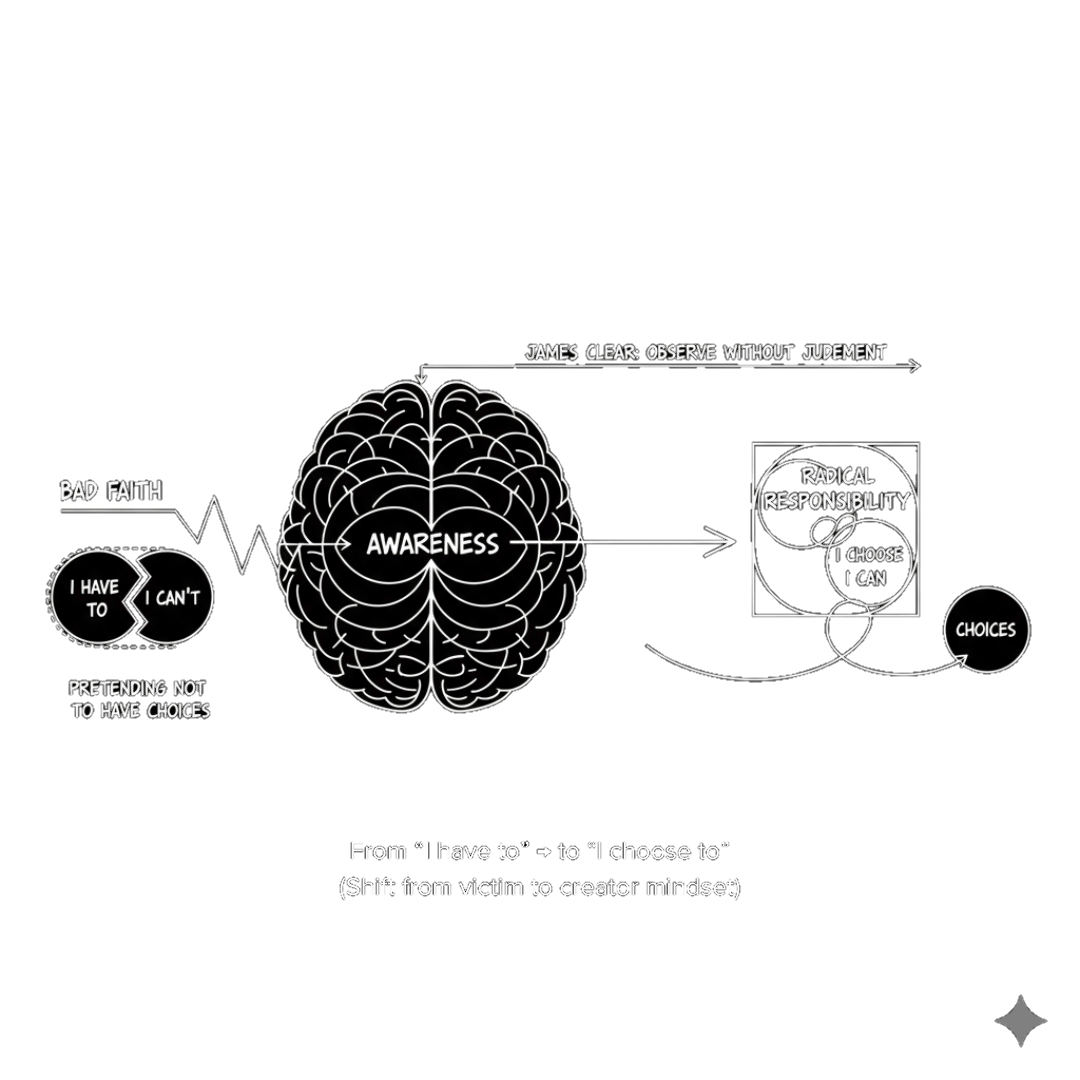
The most effective method for building this awareness is what Clear describes as Pointing-and-Calling, but applied to your freedom. When you notice yours using victim language, say out loud, “I am choosing to believe I don't have a choice here.” Hearing these words spoken aloud makes the reality of your choice undeniable ; it removes the comfortable fog of victimhood and exposes the active role you're playing in your own life.
Research from implementation intention studies shows that specific planning dramatically increases follow-thorough. In one study, 91% of people who specified when and where they’d exercise followed through, compared to just 35-38% of those who merely tracked their behavior or received motivational talks. This same principle applies to radical responsibility : the vague intention to “take more responsibility” rarely works, but the specific Implementation, “when I notice myself blaming others, I will pause and identify one way I contributed to this situation”—creates measurable change.
Building radical responsibility requires creating what we might call a Responsibility Scorecard, where you track moments when you either embraced or avoided your freedom throughout your day. Notice when you attribute outcomes to external forces versus your own choices; observe when you take ownership versus when you deflect blame. The goal isn't to judge yourself, but to see clearly where you're already exercising responsibility and where you're pretending not to have it.
The most powerful question in this process comes from Atomic Habits, slightly modified: "Does this thought pattern help me become the person who takes full responsibility for my life? Does this habit of mind vote for or against my identity as someone who shapes their own destiny?" Thoughts that reinforce your identity as the architect of your life are moving you toward radical responsibility; thoughts that conflict with this identity are keeping you trapped in bad faith.
Your identity as someone who takes radical responsibility gets reinforced each time you make a conscious choice and acknowledge that choice. When you decide to stay late at work, you reinforce “I am someone who chooses my commitments.” When you opt to skip the gym, you strengthen “I am someone who prioritize comfort over health. Every action is a vote for the type of person you believe yourself to be.
The implementation of radical responsibility follows the 11%. This week, focus on taking 11% more responsibility in one area of your life where you typically feel powerless. Identify one situation where you normally blame circumstances, and instead identify one small choice you could make to improve it. The action matters less than the mental shift from “this is happening to me” to “I am choosing how to respond to this.”
While you didn't choose the painful events that happened to you, you do choose what meaning to assign them and how to let them shape your identity. Two people can experience similar trauma: one becomes bitter and closed off, while the other becomes compassionate and resilient. The difference isn't the event itself, but the choices each person makes about how to interpret and respond to their pain.
The final stage of radical responsibility involves extending this awareness to your emotional states. While you can't always control what emotions arise, you do choose how to respond to them and what meaning to assign them. The anxiety you feel before a presentation isn't something that happens to you; it's something you interpret and respond to, either by letting it paralyze you or by using its energy to heighten your focus. The anger you feel toward a colleague isn't an external force that controls you; it's a signal that you then choose how to act upon.
This doesn't mean suppressing emotions, but rather recognizing that between stimulus and response there is a space, and in that space lies your freedom and power to choose your response. The wider you can make this space through practice and awareness, the more freedom you actually have.
The Radical Responsibility Implementation Tool
Awareness Journal
Create a simple two-column journal that review each evening:
Column 1: Where I Felt Trapped Today
Record situations where you felt powerless of victimized.
Write down the exact language you used (“I had to….” “They made me…..”)
Note the emotion you experienced in these moments.
Column 2: The Hidden Choices I Actually Had
For each trapped feeling, identify at least one alternative choice you had.
Acknowledge that staying in the situation was itself a choice.
Identify one small action you could have taken to exercise your freedom.
The Implementation Intention for Radical Responsibility:
“When I notice myself using victim language, I will pause and complete this sentence: ‘I am choosing to _______ because _________”
This simple practice, done consistently, rewires your brain from passive victim to active agent in your own life.
Stay responsible,
Zufar Algifary
The 11% Newsletter